
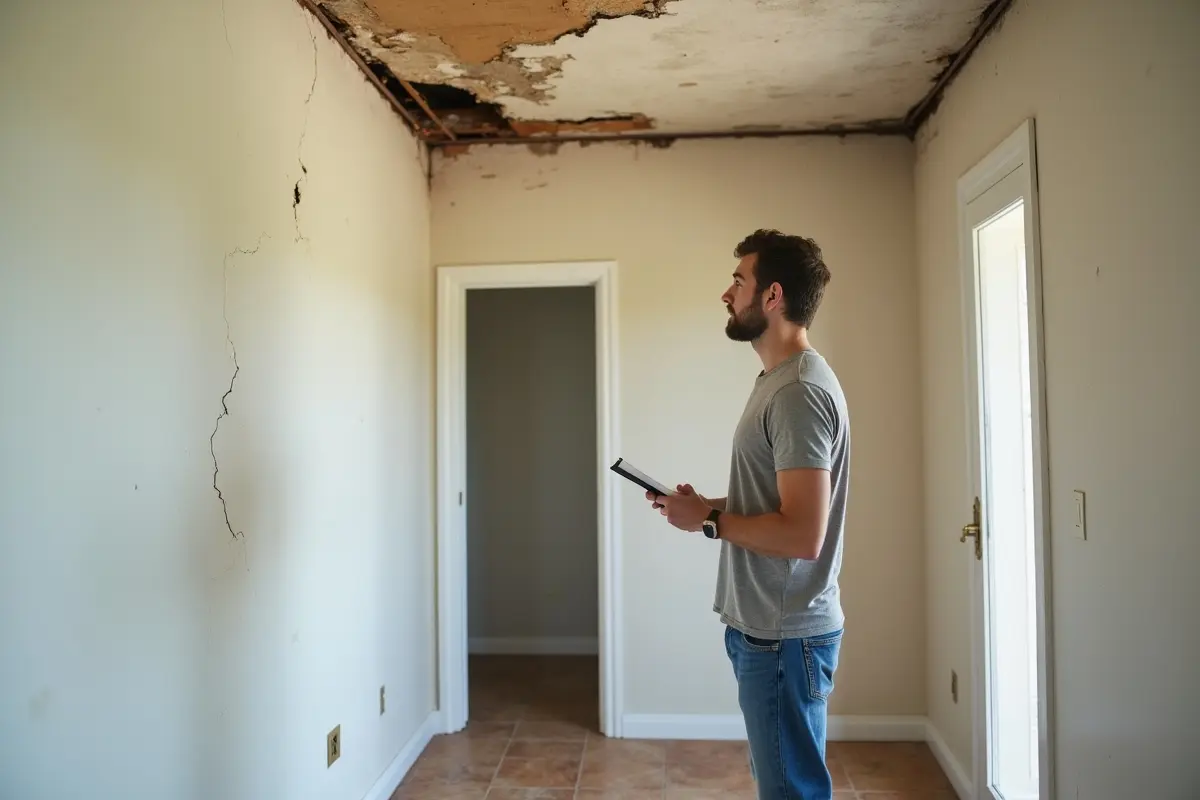
While it can be tempting to take on tasks that require a bit more know-how, express clear guidelines to your household that fiddling with the electricals is not one of them. Call in a professional electrician, or another appropriately trained person if it’s a less risky maintenance issue, but don’t DIY it.
1. You Can Smell Something Burning Near an Outlet or Switch
A smell of something burning near a power outlet isn’t just an idiosyncrasy, it’s a sign. It regularly indicates arcing, where power is jumping across a gap in a loose or decomposed connection, causing heat and slowly melting adjacent materials.
Circuit experts say it’s also one you should never ignore. As benign as it may seem, and as convinced as you might be that stray sock under the sofa could never catch alight from the careless electricals nearby, it’s a stench that can indicate a very real fire risk. The smell is caused when the insulating materials used in outlets, circuit breakers, or wiring burn due to a loose connection.
2. Your RCD or Circuit Breaker Keeps Tripping
If you feel the RCD is faulty because it gave you no problems for years and now it’s constantly tripping, it’s not the RCD. The RCD does its job or it’s rubbish, there’s no in-between. It’s far more likely that some piece of equipment in your house developed a persistent fault to earth. Most appliances will still work like this for a long time, but that fault allows live (potentially lethal) current to flow where it shouldn’t.
3. Switches or Outlets Feel Warm to the Touch
One of the most underreported warning signs because it can seem minor. A switch that’s warm or hot to the touch is not normal. Heat at a connection point almost always means resistance, and resistance in an electrical circuit means energy is being converted to heat somewhere it shouldn’t be.
This can be caused by loose connections, mismatched wire gauges, and inadequate earthing. Left alone, a warm outlet can progress to a residential structure fire without much warning. Electrical fires caused by arcing faults account for over $1.3 billion in direct property damage annually (Electrical Safety Foundation International).
4. Any Task Involving Fixed Wiring or the Switchboard
Here is a simple guideline to follow: if a repair involves the internal workings of your switchboard, any solid wiring inside the walls or ceiling, or the addition of a new power outlet, don’t attempt it yourself. This type of work is restricted by law in Australia to licensed electricians, and that’s a good thing.
Amateur electricians tend to use the wrong gauge of wire in relation to amperage, compromise the grounding and earthing systems, and fit parts that don’t conform to AS/NZS 3000 wiring rules. These pose more than just a danger to life and property, they void your insurance policy. If an unlicensed repair is identified as the source of a fire or short-circuit, most insurance companies will happily put your claim in the bin. Your protection is the Certificate of Electrical Safety an electrician holds once the job is completed. You can’t legally supply your own.
You’ll accept the wisdom of this protection if you understand the cost of an electrician. Knowing, for example, what is the typical electrician call out fee Melbourne householders pay means you can plan for the safety of professional maintenance without being shocked when the bill comes. That is an upfront, fixed charge with no hidden surprises. An insurance claim or a building fire has no such predictability.
5. Flickering Lights Across Multiple Rooms
When it comes to a single light flickering, you’re typically looking at a dying bulb or a loose fitting. Flickering impacting multiple rooms, or the whole house, is of a different order. It’s often a sign that something is wrong with the main switchboard, or a failing connection at the meter, or that the circuits are overloaded to the point where a fire is imminent.
This kind of symptom can be caused by a deteriorating neutral connection, one of the more dangerous faults in a residential system because it produces voltage fluctuations that damage appliances and, in some cases, creates shock hazards at points you’d never expect to find one.
A pro with thermal imaging equipment can scan walls and panels to find hot spots that aren’t visible from the outside. It’s not a tool you’re going to find at a hardware store.
Where the Line Actually Sits
The point of differentiation is not their capability. It’s the liability, the latent risk, and what the naked eye can’t see without the right instrumentation. A great jack-of-all-trades can master scores of home repairs. But when the problem is electrical and underground, in a box, or recurring mysteriously, the right decision is to call the specialist. That’s not waving the white flag, that’s knowing when and where to take a stand.




Leave a Reply
You must be logged in to post a comment.