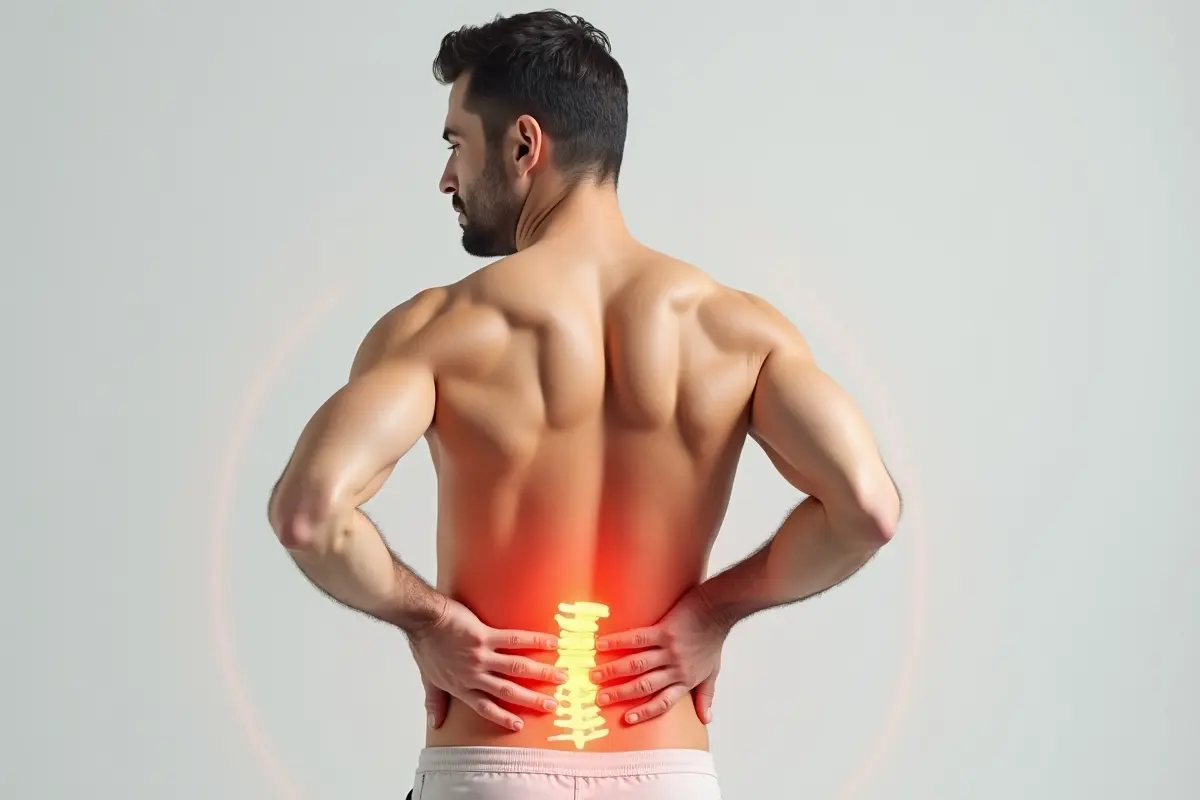
How to Tell if Your Lower Back Pain Is Actually an SI Joint Issue
Many individuals have no idea why their sacroiliac joint hurts so much to begin with, what it does, or what they can do to fix it. It’s often mistaken for a disc problem or general lower back strain, which means people can spend months treating the wrong thing. The good news is that once you know what to look for, the SI joint has a pretty distinct pain pattern that sets it apart.
In this article, we’re going to discuss the SI joint, how to recognize when it’s the source of your pain, and what you can do about it.
What The SI Joint Is And Where It Lives
The sacroiliac joint is where the sacrum – the triangular bone at the bottom of the spine – connects on each side to the ilium (the wing-shaped bone of the pelvis). We have two of these joints, one on either side of the spine. They act as shock absorbers that connect the spine to the legs. They’re not supposed to move much; a couple of degrees of rotation and a tiny amount of glide are enough to cushion the forces from our upper bodies and transmit them to the lower body.
This location is important in pinpointing the pain. The lumbar spine extends from your waistband and above. The SI joint is lower in the pelvis, closer to the dimples that you can feel either side of your lower back. Pain from a disc or muscle in the lumbar region is usually experienced higher up and more centrally. Pain from the SI joint is usually lower, to one side, and is focused almost exclusively in that dimple region.
The Pattern That Points To The SI Joint
Pain caused by sacroiliac joint dysfunction is almost always one-sided. This is one of its hallmarks. On the other hand, if you have bilateral (two-sided) lower back pain, with a similar level of pain and stiffness on both sides of your lower back, this can point you in the direction of a lumbar spine source and not the SI joint. If you can touch the spot that hurts and it’s clearly just to the left or the right of the center of your back, below your beltline, you should certainly have the SI joint on your radar as a potential cause.
The pain can spread down, but it frequently limits itself to the upper leg, groin, and buttock region and rarely radiates below the knee (for example does not radiate to the foot). This is a key differentiator from sciatic nerve irritation, where the pain travels down the back of the leg, often to the foot. If your “sciatica” does not go below the knee and remains on one side and relatively constant, it may not be sciatica at all and more likely to be pain from the SI joint.
What Conservative Treatment Looks Like
Manual therapy can be really effective for dealing with structural issues – those stuck or misaligned joints. And because the SI joint is a transfer point for the forces moving between the legs and the upper body, pelvic balance matters a lot. With its focus on applying controlled force to a hypomobile joint or correcting pelvic tilt patterns that are imposing increased stress on the ligaments, si joint pain chiropractic care is aimed at getting to the root cause of the pain and compensatory muscle spasms. If that root cause is structural, this kind of care is likely the answer.
This isn’t about cracking the back for temporary relief. The goal is to correct the mechanical problem so the tissue stops being irritated.
If you’ve been treating lower back pain for months without meaningful improvement, the diagnosis itself may be the issue. The lumbar spine isn’t always the source – and when it isn’t, treating it won’t help. Start by asking whether your pain actually fits the SI joint pattern. For many people, it does.
Triggers That Make It Worse
SI joint dysfunction is associated with a group of activities that can exacerbate it. For instance, prolonged sitting, particularly when you sit with your weight on one side, unevenly loads the joint. Over time, this may lead to a sharp, catching pain at that low pelvic location.
Going up the stairs is a source of discomfort as well. With each step, you bear the weight of your entire body through one hip, which in turn passes it through the SI joint. Individuals often realize that they’re using one leg more than the other when climbing the stairs.
Finally, standing for long periods often aggravates the pain, as you may tend to shift your weight to one side which, as previously mentioned, causes chronic mechanical strain on the sacroiliac ligaments.
A Quick Self-Check: The Fortin Finger Test
Here’s an easy test to see if your SI joint might be to blame. Try pointing with just one finger to where it hurts. If the finger lands consistently within about one inch of the bony dimple on one side of your lower back – the posterior superior iliac spine, or PSIS – that’s what’s called the Fortin finger test result. Patients with confirmed SI joint dysfunction tend to give a positive Fortin result. They point to that spot, over and over. It’s not enough to make the diagnosis on its own, but it is a telling sign that the joint, not the disc, should be the focus of the problem.
Worth noting: the test works best when your pain is in an active, easy-to-locate phase, not during a dull, generalized flare-up. If you’re having a hard time pinpointing a single spot, try the test again after a triggering activity like prolonged sitting or climbing stairs, when the pain tends to be more sharply localized.
And if you find yourself circling your whole palm around the lower back rather than landing on one clear point, that’s actually a clue pointing away from the SI joint and toward a broader muscular or lumbar source instead.
Two Different Problems That Look The Same
Not all dysfunction in the sacroiliac (SI) joint is similar, and the type of dysfunction determines the treatment approach. If the joint is hypomobile, it means it is stiff or locked within its limited range of normal movement. This normally produces an ache that’s hard to pin down. Muscles overcompensate for the loss of movement and tire in that effort. If the joint is hypermobile, that’s the SI joint that wiggles too much in response to pregnancy most often, since ligaments loosen in preparation for delivery. The compensation pattern will indicate a sacroiliac stabilization strategy rather than joint mobilization.
Getting this right matters. Treating a hypermobile joint with aggressive mobilization makes it worse. Treating a hypomobile joint with stabilization alone misses the root problem.
Either way, the first step is the same: get an accurate read on which pattern you’re dealing with before committing to a treatment plan. Once that’s clear, relief from SI joint pain is usually much closer than months of guessing would suggest.